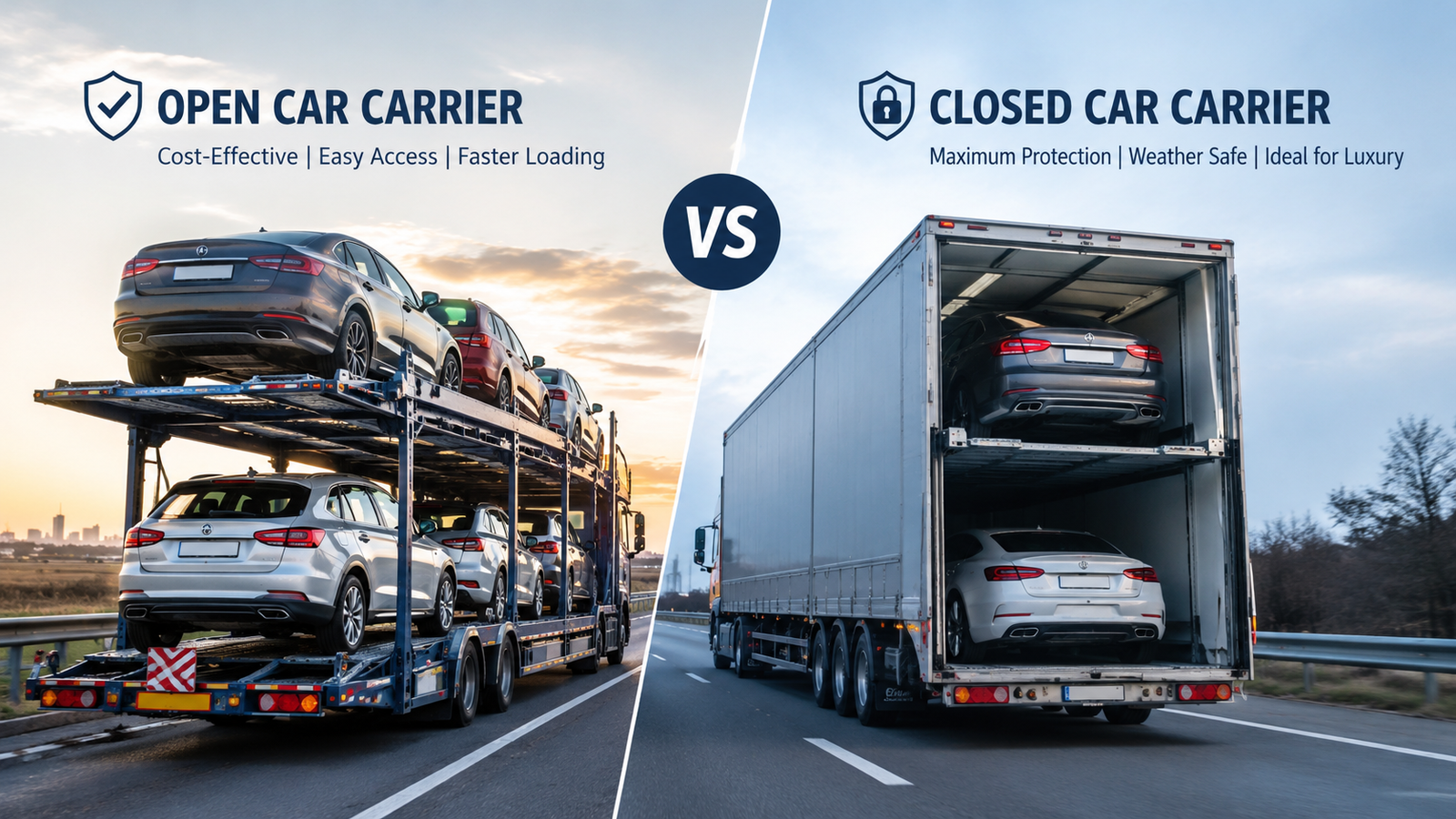
Open and Closed Car Carriers Explained
Open car carriers and closed car carriers are the two most common options for intercity car transport in India. Both are useful, but they serve different requirements. An open carrier is suitable for regular car transport when customers want a reliable and economical solution. A closed carrier provides additional protection and is preferred for luxury cars, premium cars, vintage vehicles, sports cars, and newly purchased vehicles.
What Is an Open Car Carrier?
An open car carrier is a vehicle transport trailer where cars are loaded on an open platform. It is widely used because it offers good availability, practical pricing, and efficient movement on major routes. Most standard hatchbacks, sedans, SUVs, and family cars are transported using open carriers. For customers moving from Delhi NCR to Mumbai, Bangalore, Pune, Jaipur, Chennai, Hyderabad, Ahmedabad, or Kolkata, open carrier movement is often the most practical option.
Benefits of Open Carrier Transport
The main benefit of open carrier transport is cost efficiency. Since open carriers are more commonly available, route planning is easier and pricing is usually lower than closed carrier movement. Open carriers are suitable for everyday vehicles, corporate relocations, student moves, dealer transfers, and family shifting requirements where standard professional handling is enough.
What Is a Closed Car Carrier?
A closed car carrier is covered from the outside and gives the vehicle better protection from dust, rain, road exposure, and public visibility. It is generally recommended for expensive cars, premium SUVs, imported cars, vintage vehicles, show cars, and high-value purchases. Closed carriers cost more, but customers choose them when the vehicle needs additional safety and privacy during transit.
When Should You Choose a Closed Carrier?
Choose a closed carrier if your car has high market value, delicate paint finish, low ground clearance, custom body work, or special emotional value. It is also useful when the vehicle is brand new or when the route is long and the customer wants maximum protection. Shiv Car Transport helps customers compare both options based on budget, route, vehicle type, and protection requirement.
Inspection and Loading Process
Whether the vehicle moves on an open carrier or closed carrier, the basic process should remain professional. The pickup team checks vehicle condition, notes visible marks, confirms documents, verifies contact details, and guides the customer to remove valuables and loose accessories. After inspection, the vehicle is loaded carefully and secured for movement.
Which Carrier Is Right for You?
For most regular cars, open carrier transport is a sensible and budget-friendly choice. For luxury, premium, newly purchased, vintage, or sensitive vehicles, closed carrier transport is better. The right choice depends on the vehicle value, customer expectations, route distance, season, and budget. Shiv Car Transport explains the difference clearly before booking so customers can make an informed decision.
Final Recommendation
If your priority is economical vehicle transportation, choose an open carrier. If your priority is maximum protection, choose a closed carrier. In both cases, always book with a transport team that gives clear communication, practical pickup planning, route updates, and delivery coordination.